
The conservative coupled-oscillator problem shows how elastic coupling can move mechanical energy back and forth between two tuned subsystems. Adding a damper changes the energy balance fundamentally: the coupling still provides the transfer path, but the secondary oscillator now contains a path through which mechanical energy can leave the vibration and become heat.
This article extends the conservative reference case developed in Energy Transfer and Beating in a Weakly Coupled 2-DOF System → The masses, stiffnesses and initial condition are kept unchanged so that the effect of damping can be isolated.
Energy must first reach oscillator 2 through the coupling spring. Only then can the viscous element dissipate it. This distinction is the central physical idea of the example.
The same coupled system, with one dissipative element
The mechanical layout is the same as in the undamped example. Mass \(m_1\) is connected to ground through \(k_3\), mass \(m_2\) through \(k_6\), and the masses are connected by the coupling spring \(k_5\). A viscous damper \(c_d\) is now placed between mass 2 and ground, in parallel with \(k_6\).
Porvion reports absolute horizontal coordinates \(X_1(t)\) and \(X_2(t)\). For the equations, it is cleaner to introduce displacements from the static equilibrium positions,
The initial condition used in the simulation therefore becomes
With no external force after release, the equations of motion are
In matrix form,
Where the mechanical energy goes
The mechanical energy stored in the masses and springs is
Differentiating this expression and using the equations of motion gives the central result of the damped problem:
The quantity
is the instantaneous rate at which the ideal viscous damper removes mechanical energy from the oscillation. In a real dissipative device this energy ultimately appears as internal energy, predominantly heat.
Integrating the balance from the release time to any later instant gives
The coupling spring still performs the work that moves energy between the oscillators. The new element simply prevents all of that transferred energy from being returned, because a fraction is dissipated whenever oscillator 2 moves.
Why repeated beating gradually disappears
In the conservative case, no mechanism can remove mechanical energy from the system. Energy that reaches oscillator 2 can later return through the coupling spring, producing the repeated beating pattern.
With \(c_d>0\), the first transfer still occurs: oscillator 1 excites oscillator 2 through \(k_5\). But while oscillator 2 moves, the damper dissipates energy at the rate \(c_d\dot x_2^2\). The energy available for the next return transfer is therefore smaller than before.
The process repeats while the system remains in motion, so the total mechanical energy decreases monotonically. The characteristic beating can remain visible during the early transient, but its envelope no longer repeats indefinitely. Instead, both oscillations progressively decay.
Why the frequency changes very little in this case
For the undamped symmetric reference system, the two natural frequencies are
The damping matrix used here is not proportional to the mass and stiffness matrices, so the undamped normal modes do not exactly decouple the damped system. The exact free response is therefore obtained from the complex eigenvalue problem
With \(m_1=m_2=1\ \mathrm{kg}\), \(k_3=k_6=500\ \mathrm{N/m}\), \(k_5=50\ \mathrm{N/m}\) and \(c_d=1\ \mathrm{N\,s/m}\), the characteristic equation is
whose roots are approximately
The imaginary parts remain extremely close to the undamped modal frequencies, while the negative real parts introduce an approximately \(e^{-0.25t}\) amplitude decay scale. In this reference case the visible effect of damping is therefore overwhelmingly the loss of amplitude, not a large shift in oscillation frequency.
The familiar relation \(\omega_d=\omega_n\sqrt{1-\zeta^2}\) applies directly to a decoupled single-degree-of-freedom oscillator. Here the damping is non-proportional, so the exact damped frequencies come from the complex eigenvalues of the complete 2-DOF system.
One parameter changes the physics
To isolate the effect of dissipation, every mass, spring and initial condition is kept identical to the conservative example. The only new parameter is the viscous coefficient \(c_d=1\ \mathrm{N\,s/m}\).
| Quantity | Symbol | Value | Role |
|---|---|---|---|
| Mass 1 | \(m_1\) | 1 kg | Initially displaced oscillator |
| Mass 2 | \(m_2\) | 1 kg | Damped secondary oscillator |
| Left stiffness | \(k_3\) | 500 N/m | Grounding stiffness of oscillator 1 |
| Coupling stiffness | \(k_5\) | 50 N/m | Transfers work between the oscillators |
| Right stiffness | \(k_6\) | 500 N/m | Grounding stiffness of oscillator 2 |
| Viscous damping | \(c_d\) | 1 N·s/m | Dissipates energy through motion of mass 2 |
| Initial coordinate of mass 1 | \(X_1(0)\) | 1.30 m | 0.30 m displacement from equilibrium |
| Initial coordinate of mass 2 | \(X_2(0)\) | 2.00 m | Starts at equilibrium |
| Initial velocities | \(\dot x_1(0),\dot x_2(0)\) | 0 m/s | Release from rest |
Undamped baseline
With \(c_d=0\), the system conserves mechanical energy and the beating pattern repeats indefinitely in the ideal linear model.
Damped case
With \(c_d=1\ \mathrm{N\,s/m}\), energy decreases whenever oscillator 2 has non-zero velocity.
Undamped versus damped energy exchange
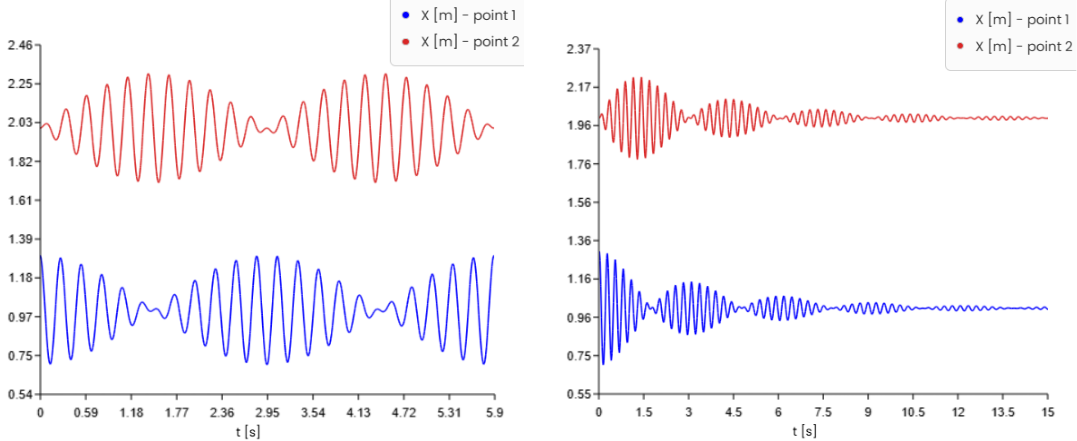
The comparison below uses the same initial displacement and the same stiffness and mass values in both simulations. In the undamped case, the slow exchange envelope repeats. In the damped case, the early transfer is still visible, but the total available mechanical energy falls continuously.
Absolute coordinates: undamped and damped response
Porvion comparison over 20 seconds. The damped response retains the coupled character of the motion while progressively losing amplitude.
More damping is not automatically better
Energy still returns repeatedly
If \(c_d\) is very small, the second oscillator receives energy but dissipates only a small fraction of it before the exchange reverses. Beating remains visible for many cycles.
Transfer and dissipation cooperate
The secondary oscillator can still move enough to receive energy, while the damper removes a meaningful fraction of that energy during each exchange. The return to the primary oscillator is strongly reduced.
The secondary motion can be suppressed
Excessive damping can restrain oscillator 2 so strongly that it no longer moves efficiently. Since dissipation requires velocity, the ability to draw energy through the coupling path can eventually worsen.
This is why damping design is an optimization problem rather than a rule of simply making \(c_d\) as large as possible. The useful value depends on the mass ratio, coupling stiffness, frequency content of the excitation and the response quantity that must be reduced.
Why indirect dissipation can be useful
The example demonstrates a general vibration-control idea: the dissipative element does not necessarily have to act directly on the degree of freedom whose motion we want to reduce. If a secondary subsystem is dynamically coupled to the primary one, it can receive part of the vibrational energy and provide a separate location where that energy is dissipated.
Dissipation can be located elsewhere
A secondary device can be useful when attaching a damper directly to the protected component or to a rigid reference is difficult.
The dynamics can target a frequency region
The mass and stiffness of the secondary subsystem can be chosen so that it interacts strongly with a particular mode or frequency range.
The dissipative device can be separated
Energy dissipation can be concentrated in an added component that may be easier to design, inspect, replace or tune than the primary structure.
These advantages do not make indirect damping universally superior to direct damping. If a suitable direct damper can be installed on the primary structure, it may be simpler and more broadband. A secondary absorber adds parameters, sensitivity to tuning and an additional moving mass.
A conceptual bridge, not a classical tuned mass damper
The mechanism shown here is closely related to the idea behind dynamic vibration absorbers: motion of a primary system transfers energy into a secondary subsystem, where the response can be controlled or dissipated. Classical absorber theory has exploited this principle for nearly a century [4].
The present geometry should nevertheless be named carefully. It is not the canonical tuned mass damper. In this Porvion model, oscillator 2 is itself connected to ground through \(k_6\) and \(c_d\). In the classical tuned mass damper, the secondary mass is instead connected to the primary structure by its spring and damper and is not independently grounded.
It captures the physics of the present model without implying that the geometry is identical to a standard tuned mass damper.
What this model does—and does not—show
The model uses linear springs, lumped masses and an ideal linear viscous damper. Motion is one-dimensional, there is no external forcing after the initial release, and the damping coefficient is constant. The example is therefore a transient free-vibration problem, not a complete design study of a vibration absorber under harmonic or broadband forcing.
Within those limits, the system isolates one important mechanism with very little mathematical clutter: energy can be removed from a primary oscillator without placing the dissipative element directly on it, provided that dynamic coupling creates an effective path toward a damped secondary subsystem.
Core result
- The coupling spring transfers work between the two oscillators.
- The damper removes mechanical energy only when oscillator 2 moves.
- The total mechanical energy satisfies \(\dot E=-c_d\dot x_2^2\le0\).
- With \(c_d=1\ \mathrm{N\,s/m}\), the main visible effect is amplitude decay rather than a large frequency shift.
- Repeated beating is progressively suppressed because part of the transferred energy is no longer available to return.
- More damping is not automatically better because excessive damping can inhibit the secondary motion required for energy transfer.
References and further reading
The energy-transfer interpretation follows the classical literature on power flow between coupled oscillators. The final reference provides the historical connection to dynamic vibration absorbers.
-
C. A. Mercer, P. L. Rees, and F. J. Fahy,
“Energy flow between two weakly coupled oscillators subject to transient excitation.”
Journal of Sound and Vibration,
vol. 15, no. 3, pp. 373–379, 1971.
doi:10.1016/0022-460X(71)90431-7 ↗ -
R. H. Lyon and G. Maidanik,
“Power Flow between Linearly Coupled Oscillators.”
The Journal of the Acoustical Society of America,
vol. 34, no. 5, pp. 623–639, 1962.
doi:10.1121/1.1918177 ↗ -
D. E. Newland,
“Calculation of power flow between coupled oscillators.”
Journal of Sound and Vibration,
vol. 3, pp. 262–276, 1966.
doi:10.1016/0022-460X(66)90095-2 ↗ -
J. Ormondroyd and J. P. Den Hartog,
“The Theory of the Dynamic Vibration Absorber.”
Transactions of the ASME,
vol. 50, pp. 9–22, 1928.
doi:10.1115/1.4058553 ↗
Rebuild the model and vary the damping coefficient.
Start from \(c_d=1\ \mathrm{N\,s/m}\), then decrease or increase the damping while keeping every other parameter fixed. Compare how long the beating remains visible, how quickly the amplitudes decay, and how strongly the secondary oscillator is allowed to move.