
The system considered here is deliberately simple: two translating masses, two grounding springs and one coupling spring. Yet this model contains a central idea of vibration theory. Elastic coupling creates a path for mechanical work to pass from one subsystem to the other, while tuning determines how efficiently that exchange can develop. When the coupled natural frequencies are close, the time response exhibits beating and the vibrational energy migrates periodically between the two oscillators.
The physical transfer is caused by the coupling force. Beating is the time-domain pattern generated by the superposition of the system's two nearby modal frequencies, and therefore reveals the slow exchange process.
The system and its assumptions
Let \(x_1(t)\) and \(x_2(t)\) denote the horizontal coordinates of the two masses along the line of motion. Mass \(m_1\) is connected to ground by stiffness \(k_3\), mass \(m_2\) by stiffness \(k_6\), and the two masses are connected by the coupling stiffness \(k_5\).
The present example is conservative: there is no viscous damping and no external forcing after the initial condition is imposed. This idealization is intentional. It isolates the exchange mechanism before dissipation is introduced.
Written component by component, the equations are
The coupling force acting on the second mass is \(F_{c,2}=k_5(x_1-x_2)\), while the first mass receives the equal and opposite force \(F_{c,1}=k_5(x_2-x_1)\). These forces are the physical channel through which the two subsystems exchange energy.
Why matching the uncoupled natural frequencies matters
If the coupling spring were removed, the two oscillators would have the natural frequencies
Efficient exchange is obtained when these frequencies are equal or close:
The reason is physical. At the beginning of the motion, if the first mass is displaced while the second is almost stationary, the coupling force on mass 2 is approximately
The first oscillator therefore acts, temporarily, as the source of an oscillatory excitation for the second. When \(x_1(t)\) evolves near \(\omega_{01}\) and \(\omega_{01}\approx\omega_{02}\), the second oscillator is excited close to its own natural frequency. Its response can then build efficiently. As \(x_2\) grows, however, the second oscillator can no longer be regarded as a passive forced system: its motion changes the coupling force and acts back on the first mass.
Equal masses are not a fundamental requirement. For example, \(m_2\neq m_1\) may still be tuned by choosing \(k_6/m_2=k_3/m_1\). Equal masses and equal outer stiffnesses are simply the most symmetric—and therefore the cleanest—case.
The symmetric system: two nearby normal frequencies
Consider the symmetric case
The eigenproblem \(\det(\mathbf K-\omega^2\mathbf M)=0\) gives two normal frequencies:
The associated mode shapes may be written as
In the first mode the masses move in phase. Their relative displacement is zero, so the coupling spring does not deform and therefore contributes no additional stiffness. In the second mode the masses move in opposite directions, the coupling spring deforms strongly, and the corresponding natural frequency is higher.
If \(k_5\ll k\), the two frequencies remain close. Introducing the coupling ratio
a first-order expansion gives
Weak coupling therefore has two simultaneous effects: it leaves the fast oscillation frequency close to that of the isolated oscillators, while creating a much slower time scale governed by the small frequency splitting \(\Delta\omega\).
How the slow envelope emerges
Displace only the first mass and release the system from rest:
For the symmetric system, this initial displacement excites the two modes with equal amplitude because
The resulting coordinates are
Applying standard trigonometric identities gives
The response therefore contains a fast oscillation at approximately the average frequency and a slow amplitude modulation controlled by \(\Delta\omega=\omega_2-\omega_1\). When the envelope of \(x_1\) decreases, the envelope of \(x_2\) increases. The first envelope minimum of the initially excited mass occurs at
This is the characteristic time for the first near-complete transfer of vibrational energy from one oscillator to the other. The full exchange cycle—energy leaving the first oscillator and later returning to it—has the time scale
The displacement envelope of \(x_1\) reaches zero exactly in the ideal symmetric solution. That does not imply that the complete mechanical energy of oscillator 1 is exactly zero at the same instant, because its velocity need not vanish simultaneously. Under weak coupling the residual kinetic energy is small, so the transfer is appropriately described as near-complete.
The physical mechanism: work done by the coupling spring
Modal superposition explains why the response has an envelope, but the physical path of energy transfer is the coupling force itself. Energy and power flow between weakly coupled oscillators has a long analytical literature [2][3], including transient formulations directly related to the present case [1]. The instantaneous powers delivered by the coupling spring to the two masses are
When \(P_1<0\), the coupling force removes mechanical energy from mass 1. When \(P_2>0\), it supplies mechanical energy to mass 2. The coupling spring itself can temporarily store energy,
and the power balance satisfies
Thus the spring does not create or destroy energy. It alternately stores and releases it while transferring work between the two moving subsystems.
The total mechanical energy is
Because the system is conservative, the energy cannot disappear. Once the second oscillator has received most of it, the evolving phase relation eventually reverses the net work flow and the energy returns toward the first oscillator. This is why the beating pattern repeats.
A concrete weak-coupling simulation
The following parameter set produces a clear beating response while keeping the coupling stiffness small compared with the outer stiffnesses.
| Quantity | Symbol | Value | Role |
|---|---|---|---|
| Mass 1 | \(m_1\) | 1 kg | Initially displaced oscillator |
| Mass 2 | \(m_2\) | 1 kg | Initially at the reference coordinate |
| Left stiffness | \(k_3\) | 500 N/m | Grounding stiffness |
| Coupling stiffness | \(k_5\) | 50 N/m | Weak elastic coupling |
| Right stiffness | \(k_6\) | 500 N/m | Grounding stiffness |
| Initial coordinate of mass 1 | \(x_1(0)\) | 1.30 m | Absolute initial coordinate |
| Initial coordinate of mass 2 | \(x_2(0)\) | 2.00 m | Absolute initial coordinate |
| Initial velocities | \(\dot x_1(0),\dot x_2(0)\) | 0 m/s | Zero initial velocities |
In Porvion, one convenient geometry is to place the left support at \(X=0\), mass 1 at the equilibrium coordinate \(X=1\,\mathrm m\), mass 2 at \(X=2\,\mathrm m\), and the right support at \(X=3\,\mathrm m\). Use a rest length of \(1\,\mathrm m\) for all three springs, so \(L_{0,3}=L_{0,5}=L_{0,6}=1\,\mathrm m\). The initial condition is then obtained by placing mass 1 at \(X=1.30\,\mathrm m\) while leaving mass 2 at \(X=2.00\,\mathrm m\).
Analytical frequencies
The in-phase mode remains at the isolated oscillator frequency, while the anti-phase mode is shifted upward by the coupling.
Exchange time
The small modal frequency separation determines the much slower transfer time.
What the beating response looks like in Porvion
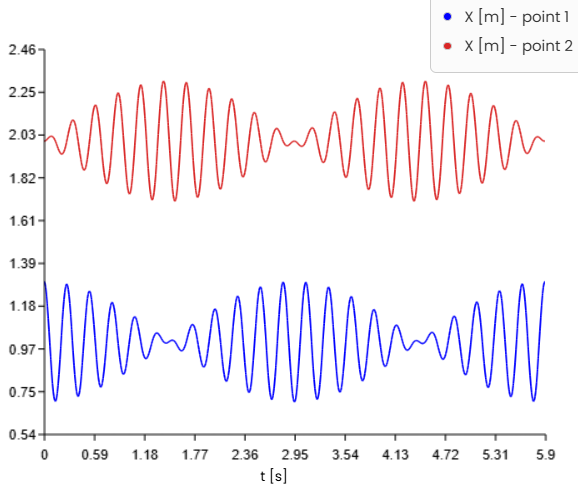
The figure below reports the two absolute coordinates \(x_1(t)\) and \(x_2(t)\) obtained from the Porvion simulation of the reference case. It shows the characteristic signature of beating very clearly: when the oscillation amplitude of one mass tends to decrease, the other tends to reach its largest amplitude, and the exchange later reverses.
In other words, the system does not simply exhibit two unrelated oscillations. The weak coupling spring allows energy to pass back and forth, and the slow modulation of the two coordinate traces is the visible consequence of that exchange.
Absolute coordinates \(x_1(t)\) and \(x_2(t)\)
Porvion response for the symmetric weakly coupled reference case. The two traces make the alternating amplitude growth and decay immediately visible.
What changes when the system is no longer perfectly symmetric?
Change \(k_6/m_2\)
If \(\omega_{02}\) moves away from \(\omega_{01}\), the second oscillator is no longer excited near its own natural frequency. Energy transfer becomes less efficient.
Reduce \(k_5\)
The modal frequencies move closer together, so the beating becomes slower. In the weak-coupling limit, \(t_{\mathrm{tr}}\propto1/k_5\).
Keep tuning, change \(m_2/m_1\)
Equal uncoupled natural frequencies do not guarantee the same modal participation. The exchange remains tuned, but the primary displacement need not collapse as completely.
Tuned but unequal masses
Suppose the oscillators remain exactly tuned,
while \(m_1\neq m_2\). The two modal frequencies become
The first mode remains proportional to \([1,1]^T\), but the second mode is now proportional to
With the initial condition \([A,0]^T\), the first coordinate is
Only when \(m_1=m_2\) do the two modal contributions to \(x_1\) have equal amplitudes and therefore possess the ability to cancel completely. This distinction separates frequency tuning from dynamic matching.
Why this simple system matters
Beating is often introduced as a mathematical consequence of adding two close frequencies. In a coupled mechanical system, however, it also carries structural information. A slowly varying envelope can reveal closely spaced modes, weak coupling between subsystems, and a slow migration of vibrational energy that may not be apparent from only a few cycles of motion.
The same mechanism provides the conceptual bridge toward dynamic vibration absorbers. A secondary oscillator is tuned so that motion of the primary structure can transfer energy into it. If damping is then added to the secondary subsystem, part of that transferred energy is irreversibly dissipated instead of returning to the primary structure.
The conservative example studied here is therefore not merely a visual demonstration of beating. It isolates the energy-transfer mechanism that underlies a broader class of vibration-control concepts, including the classical dynamic vibration absorber [4].
What this model does—and does not—represent
The present analysis assumes linear springs, lumped masses, one translational degree of freedom per mass, no damping, and no external forcing after release. Real systems contain dissipation and may include nonlinear stiffness, distributed inertia and additional modes. Damping causes the total mechanical energy to decay and gradually suppresses repeated energy return.
These limitations do not invalidate the example. They define its purpose: to isolate the conservative coupling mechanism and make the relation between tuning, modal splitting, beating and energy exchange transparent before additional physical effects are introduced.
Core result
- The coupling spring provides the physical path for work to pass between the oscillators.
- Matching the uncoupled natural frequencies makes that exchange efficient.
- Weak coupling creates two nearby natural frequencies.
- Their superposition produces the beating envelope observed in the time response.
- The slow time scale of energy exchange is governed by \(\Delta\omega=\omega_2-\omega_1\).
- Beating is therefore the observable signature of the exchange, not its physical cause.
References and further reading
The analytical interpretation used in this example follows the classical literature on power and energy flow between weakly coupled oscillators. The final reference provides the historical connection to tuned dynamic vibration absorbers.
-
C. A. Mercer, P. L. Rees, and F. J. Fahy,
“Energy flow between two weakly coupled
oscillators subject to transient excitation.”
Journal of Sound and Vibration,
vol. 15, no. 3, pp. 373–379, 1971.
doi:10.1016/0022-460X(71)90431-7 ↗ -
R. H. Lyon and G. Maidanik,
“Power Flow between Linearly Coupled
Oscillators.”
The Journal of the Acoustical Society
of America,
vol. 34, no. 5, pp. 623–639, 1962.
doi:10.1121/1.1918177 ↗ -
D. E. Newland,
“Calculation of power flow between
coupled oscillators.”
Journal of Sound and Vibration,
vol. 3, pp. 262–276, 1966.
doi:10.1016/0022-460X(66)90095-2 ↗ -
J. Ormondroyd and J. P. Den Hartog,
“The Theory of the Dynamic Vibration
Absorber.”
Transactions of the ASME,
vol. 50, pp. 9–22, 1928.
doi:10.1115/1.4058553 ↗
Rebuild the model and change one parameter at a time.
Start with the symmetric reference case, then change the coupling stiffness, detune the second oscillator, or modify the mass ratio while preserving \(k/m\). Each change isolates a different part of the physics.